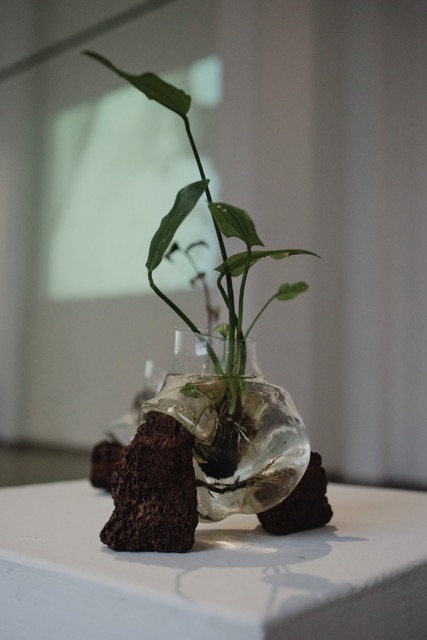
Devenires Transespecie, Galería Municipal, Querétaro, Mexico, December 2023 – February 2024. Curated by Mónica Garrido.
To become is to transform. Evolving through profound relationships of mutual care allows living beings to adapt to other forms of existence, becoming stronger and more resilient. This happens at a biological level and in our human relationships alike.
Devenires Transespecie explores the temporary connections between bacteria and plants, the fundamental bonds between algae and fungi, and the indissoluble relationship between microorganisms and humans. In all these relationships, beings transform upon connecting with the other, giving rise to new species that sustain life. These relationships are far more common than we imagine and constitute the fundamental mechanism of evolution.
The works are gestures and narratives in which the tension between rock and crystal, light, cyanotypes, and collage materialise the forms of endosymbiosis, of living inside one another, with all its beauty and complexity, and with the pain and discomfort of yielding space to the other to allow this connection.
Built through collaborations with Malitzin Cortes (MX), Carolina Páez (CO), Andrew Carnie (UK), Yun Lam (HK), and Roland van Dierendonck, Devenires Transespecie seeks to transform our understanding of the living as relationships of mutual care.
Legado de Lynn Margulis Cyanotype series, 2023
Legado de Lynn Margulis is a series of cyanotypes produced during a residency at Cultivamos Cultura, Portugal. Working across multiple scales, some in dialogue with microscopy, the images make visible the relationships between species that sustain life: the structure fungi offer to bacteria and algae, forming lichen, and the way legume roots open to receive bacteria within themselves, forming the nitrogen-fixing nodules that allow plants to thrive.
The series is dedicated to the work of Lynn Margulis, the biologist who first proposed that endosymbiosis, the condition of living inside another organism, is the fundamental mechanism of evolution. These cyanotypes are an effort to give that invisible relationship a form.


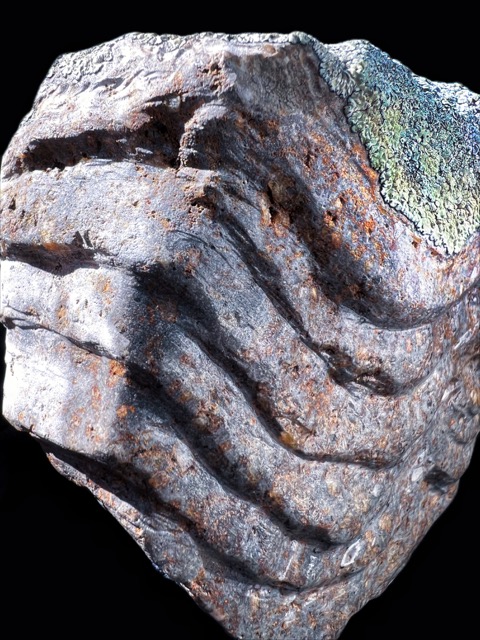
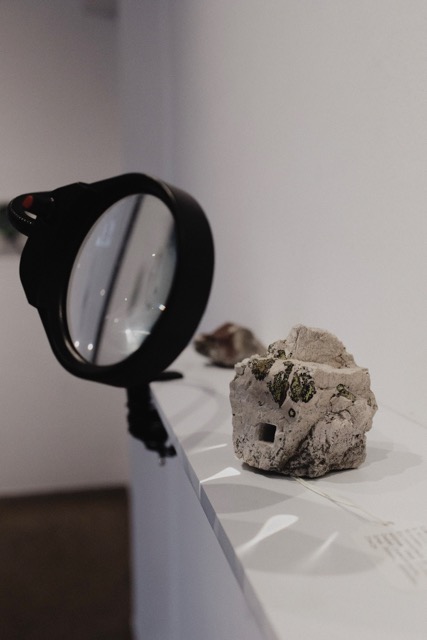
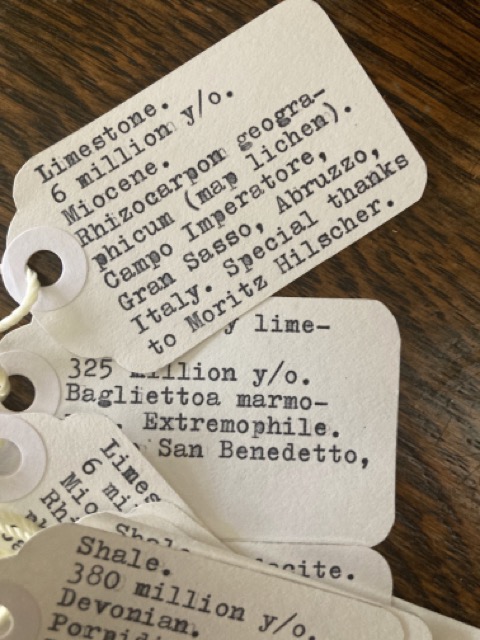
Paisajes de Tiempo Profundo Collection of lichen on sculpted rocks, 2023
Lichens are organisms consisting of at least three distinct kingdoms: bacteria, fungi, and algae. Living in symbiosis, they protect and feed one another, and in doing so inscribe themselves onto stone, growing at a rate of two millimetres per year. These trans-species relationships are inseparable from the rock they inhabit, itself millions of years old.
Paisajes de Tiempo Profundo is a collection of living sculptures gathered through hiking trips across Mexico, Italy, Ireland, and Portugal. The rocks are also shaped by human erosion, a gesture that places human time within biological and geological scales, asking where we belong within a temporality far older than our own.

Emancipación Microbiana Bronze reliquary, 3D animation, VR environment, 2020. In collaboration with Malitzin Cortes and Yun W Lam
Emancipación Microbiana visualises our deep relationship with bacteria and our evolution as trans-species organisms. Looking at the history of our cells, we find traces of an ancient bacterium in our mitochondria. It is now known that mitochondria were once independent bacteria, engulfed by larger archaea, which lost their genetic independence and became part of eukaryotic cells. They are now present in most of our cells.
The work consists of a bronze reliquary containing mitochondria extracted from the artist’s blood, a 3D-animated video depicting symbiogenesis, and a VR environment. Together they create a ritual, a sacrifice, an offering and a test, undoing the relationship to make it visible. We have known about the bacterial past of mitochondria for decades, thanks to the work of Lynn Margulis. Emancipación Microbiana makes it material.


Ceras Anatómicas Wax anatomical models, 2023
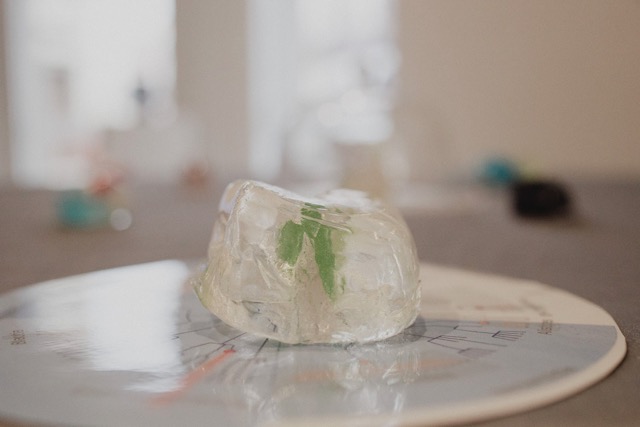
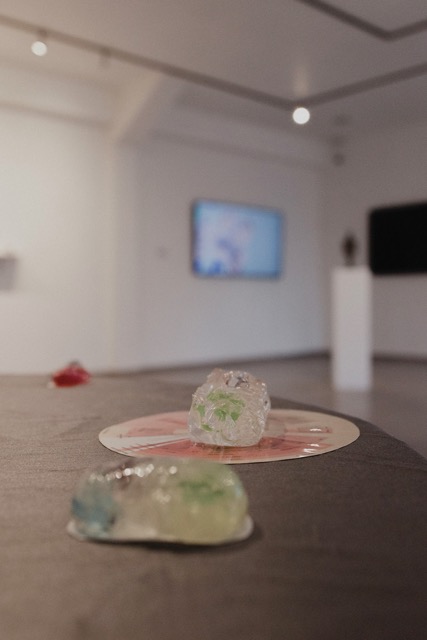
Ceras Anatómicas draws on the seventeenth century tradition of anatomical wax modelling, in which wax was used to render the interior of the human body visible and teachable. Here that tradition is redirected: the bodies under observation are not human but microbial. These wax sculptures propose an anatomy of organisms too small to see, inviting imagination where the eye cannot go.



Retrato Microbiológico de las Salinas de Yucatán Winogradsky column and cantera, 2022
Retrato Microbiológico de las Salinas de Yucatán is a microbial portrait of an ecosystem, rendered in the medium of a Winogradsky column: a method for studying microorganisms not in isolation but within the full complexity of their interrelationships. The column contains water and mud collected directly from the Yucatán salt marshes, held in glass. Its pink tone comes from halophilic microorganisms, extremophiles that thrive in high salinity environments.
Beside the column, a piece of cantera stone is carved in the shape of the small connection between the marshes and the sea, a contact that sustains the salinity these organisms require and that human development has progressively closed off.

Naturalezas Muertas con Líquenes Light boxes, 2023
Naturalezas Muertas con Líquenes is a collection of small lichen arrangements presented as light boxes. Lichens can only exist through a deep partnership between a fungal structure and a photosynthetic partner, a cyanobacterium or microscopic algae, together with other microorganisms working as a single unit. As Lynn Margulis argued, these collaborations are not peripheral to evolution but central to it.
The still life is a genre historically concerned with transience, abundance, and the beauty of the perishable. Here it is redirected toward the microscopic and the ancient: organisms whose forms of collaboration predate human life by billions of years. The symmetry of each arrangement is a gesture toward anatropism, the use of bilateral symmetry in composite forms found across Mesoamerican visual cultures.


Arquitecturas Microbianas One-minute video loop, 2023 In collaboration with Roland van Dierendonck
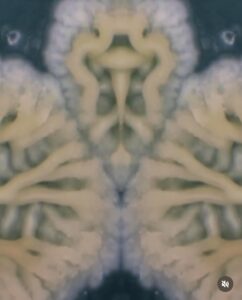
Arquitecturas Microbianas is a one-minute video loop exploring the landscape of the biofilm. Biofilms are structures built collectively by microorganisms, organised according to a defined internal architecture.
The video moves through these structures as if through a landscape, inviting reflection on microbial cognition: the capacity of microorganisms to organise, communicate, and build collectively.



Colaboración Endosimbiótica Collage: drawing, cyanotype, and sculpture, 2023 In collaboration with Andrew Carnie
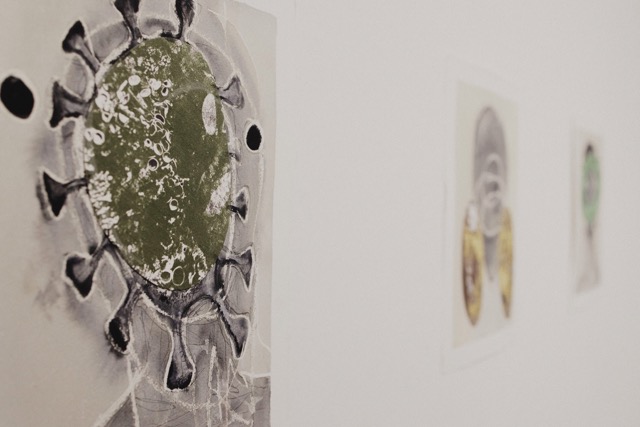
Colaboración Endosimbiótica takes the lichen as its structural model. In a lichen, the fungus provides architecture and protection while the photosynthetic partner brings energy. Here that dynamic is enacted between two artists: Carnie as supporting structure, Pebo as the collaborator bringing vital energy. Neither role is subordinate. Both are necessary for the organism to exist.
The work materialises as a collage combining drawing, cyanotype, and sculpture, the synthesis of two distinct contributions becoming one inseparable form.


Also in this exhibition: El Libro de Etl (2023) — For a full description of this work, see Futuros Ancestrales. Relaciones Ancestrales (2023, in collaboration with Carolina Páez) — For a full description of this work, see The Death of a Naturalist.
Credits
Curated by Mónica Garrido
Photography by Mónica Garrido, unless otherwise indicated
Galería Municipal, Querétaro, Mexico December 2023 — February 2024